Treat thyroid nodules without surgery — no cut, no scar, back to routine the same day.
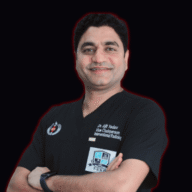
Radiofrequency Ablation (RFA) is a minimally invasive, image-guided alternative to thyroidectomy for eligible benign nodules — performed under local anaesthesia by Dr. Ajit Yadav, Senior Consultant, Department of Interventional Radiology, Sir Ganga Ram Hospital.
Nodule volume prior to treatment
Why eligible patients are choosing ablation over thyroidectomy
Suitability is confirmed after ultrasound and biopsy (FNAC) review — not every nodule qualifies for ablation. Below is a general comparison for benign, symptomatic nodules.
Radiofrequency Ablation
- No incision — needle-sized entry point only
- Local anaesthesia, fully awake throughout
- Day-care procedure, typically 30–60 minutes
- Healthy thyroid tissue is preserved
- Most patients resume routine activity within a day
Conventional Thyroidectomy
- Surgical incision with visible neck scar
- General anaesthesia required
- Hospital stay of 1–3 days
- Partial/total gland removal in most cases
- Longer recovery; lifelong medication if total removal
Your treatment pathway, start to follow-up
Consultation & Ultrasound
Nodule size, characteristics and prior FNAC reports are reviewed to confirm you're a suitable candidate for ablation.
Local Anaesthesia
The skin and surrounding tissue are numbed. You remain awake and comfortable through the procedure.
RFA Under Live Imaging
A thin probe delivers controlled heat to the nodule under continuous ultrasound guidance using the moving-shot technique.
Recovery & Follow-up
Short observation period, then discharge the same day. Follow-up ultrasound tracks nodule shrinkage over subsequent months.

Dr. Ajit Yadav
MBBS, DNB, FVIR, EBIR
Senior Consultant, Interventional Radiology
Sir Ganga Ram Hospital, New Delhi
A leading voice in interventional radiology in Delhi
Dr. Ajit K. Yadav is a Senior Consultant and Vice-Chairperson at the Department of Interventional Radiology, Sir Ganga Ram Hospital, New Delhi, and one of the best-regarded vascular and interventional radiologists practising in the city. After completing his medical degree at Pt. B.D. Sharma PGIMS, Rohtak, he served as a medical officer at a rural government hospital before completing his residency in radiodiagnosis at Sir Ganga Ram Hospital.
He was nationally board-certified in 2011 and went on to complete a fellowship in Interventional Radiology at GRIPMER, Delhi, followed by advanced training at MD Anderson Cancer Center (Houston, USA) and Seoul National University Hospital (South Korea). Beyond thyroid ablation, he offers minimally invasive treatment for varicose veins, liver disease, and traumatic bleeding.
Education & Training
- MBBSPt. B.D. Sharma PGIMS, Rohtak
- Residency, RadiodiagnosisSir Ganga Ram Hospital, New Delhi
- National Board Certification2011
- Fellowship, Interventional RadiologyGRIPMER, Delhi
- Short-Term FellowshipMD Anderson Cancer Center, Houston, USA (2013)
- Specialised Training, TACESeoul National University Hospital, South Korea (2014)
Memberships & Leadership
- Member, Indian Radiological and Imaging Association (IRIA)
- Member, Indian Society of Vascular and Interventional Radiology (ISVIR)
- Member, Cardiovascular and Interventional Radiological Society of Europe (CIRSE)
- Secretary, ISVIR
- President-Elect, IRIA Delhi
- Active educator and mentor to IR residents & fellows
Before you book, here's what most patients ask
The procedure is done under local anaesthesia, so most patients report only mild pressure or warmth rather than pain. Any discomfort is usually manageable and short-lived.
No surgical incision is made. A fine needle-sized entry point is used, which typically heals without a visible scar.
In many eligible benign-nodule cases, only the nodule is treated and surrounding healthy thyroid tissue is preserved, which can reduce the likelihood of needing lifelong replacement medication compared to total gland removal. This depends on your specific case and is discussed during evaluation.
Patients with symptomatic, biopsy-confirmed benign thyroid nodules who wish to avoid surgery are generally considered. An ultrasound and review of your FNAC report during consultation confirms suitability.
It's a day-care procedure — most patients go home the same day and resume normal, non-strenuous activity within 24 hours.
Coverage varies by insurer and policy. Our team can help you check eligibility and provide documentation for your claim once your treatment plan is confirmed.
Speak with Dr. Yadav's team about your nodule
Share a few details and our clinical coordinator will call you back to schedule an ultrasound review and consultation.
- Free initial phone consultation
- Review of existing ultrasound / FNAC reports
- Serving Delhi, Gurugram, Noida & Faridabad